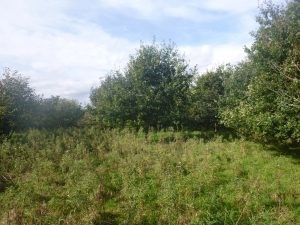
The Allan Water Improvement Project (AWIP) worked with Nether Cambushinnie Farm to develop and submit its first Agroforestry application to SRDP’s Forestry Grant Scheme this winter. The scheme, if successful, will see 4 ha of sessile oak (Quercus patraea) and silver birch (Betula pendula) planted on the Allan Water floodplain in a manner that will benefit both agriculture and the environment. Although Agroforestry is common globally from America to Africa, planned agroforestry whereby the trees have been planted for that purpose is not common in Scotland or the UK. In fact, during the time of application this was the only Agroforestry application in Scotland applying to the SRDP’s Forestry Grant Scheme.
Agroforestry is a combination of silviculture and agriculture that allows a crop of trees to be grown on the same field that is being grazed by livestock (silvopastoral) and/or is used for arable crops (silvoarable). The system increases the productivity of the land to the farmer by the addition of an extra tree crop. This agricultural strategy to grow upwards by using trees as well as at ground level is often described in agroforestry circles as farming in 3D. This method of farming can provide shelter for livestock, reduce topsoil loss through wind or run off, an earlier and later bite of grass for livestock (reducing feed costs), improve drainage of standing water via roots and an additional income of timber from the land.
The farmer at Nether Cambushinnie saw the advantage of farming in 3D and how he could fit this in with his current crop cycle which involves 5 years of sheep grazing followed by two year of arable oat crops. The AWIP saw this as an opportunity to achieve floodplain woodland at this location and the benefits that come from it. Floodplain woodland here would provide organic inputs and cover for riverfly life, which in turn benefits salmon and trout in the river. In addition, the rugosity added to the floodplain by planting rows of trees will also contribute to attenuating downstream flood risk by slowing flood water travelling over the floodplain and increasing water depth and storage. The biodiversity of fauna and flora that would utilise the trees would also benefit the wider river ecology of the area.
To achieve this, we had to work with the farmer to design an agroforestry system that was right for them and maintained current grazing and crop cycles on the land. We came up with a design that ensured there was space between rows of trees that allowed sheep grazing and convenient oat crop harvesting. Native tree species silver birch and sessile oak were selected due to their attributes being very suitable for the site and will be individually protected from roe deer and sheep by using posts and wire mesh. The sessile oak is a high value timber species that is shade tolerant and slow growing, whilst the silver birch has a lower timber value, lighter canopy and is faster growing. The species accompany one another well as the birch will act as a nurse tree by growing faster than the oaks which encourages them to have a straight stem required for valuable timber. As the lighter canopy birch grows, the shade tolerant oaks should not suffer stress before the birches are harvested, which will then provide room for the oaks to continue growing. This is the theory anyway, as far as we know, it has never been tried before. Thankfully, agroforestry experts provided us with reassuring and supportive words after looking at the design.
This is an exciting project that combines the benefits of floodplain woodland by rivers with agricultural good practice and increased productivity for the farmer. Hopefully, if our application is successful, we can achieve more 3D farming in the Forth district rivers going forward, which has the potential to benefit all.