
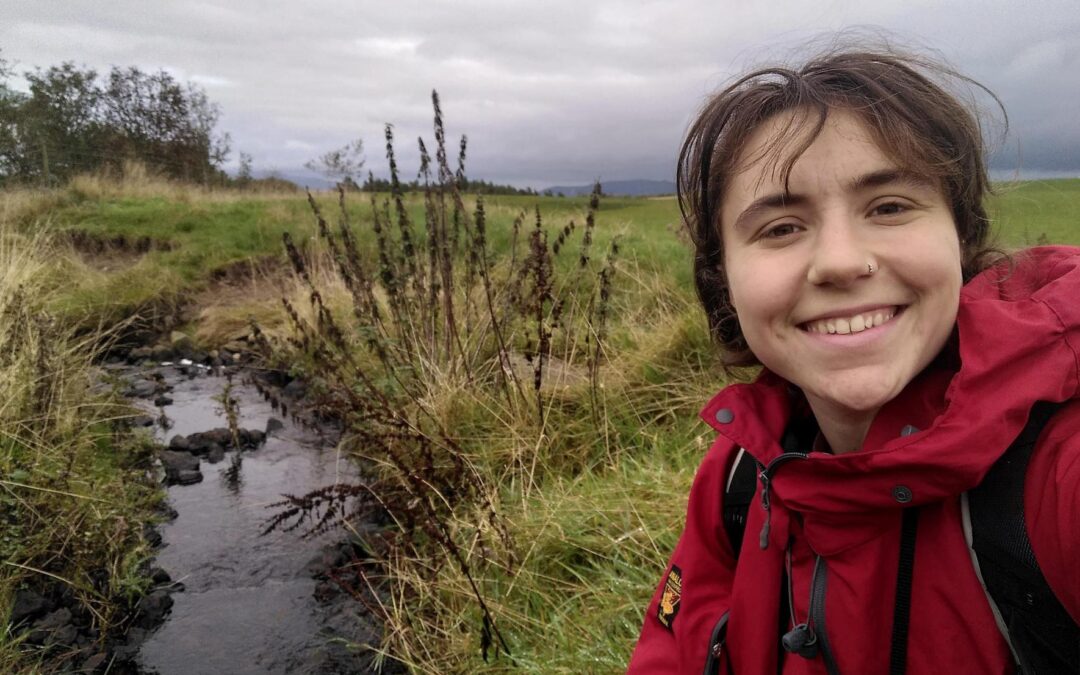
For the past three weeks, I have explored the depth of the Leven catchment and its tributaries. I have ventured along burns through dark forestry plantations with reeds and bulrushes on the banks of the burns higher than myself. I have come across lovely gorges and small waterfalls. I have waded beneath bridges with the rumble of cars above me and walked across other bridges with the rustling sound of water under me.

Me on at the upper reaches of the North Queich
What are INNS?
Non-native plants are species that exist outside their natural range because they have been introduced, directly or indirectly, by humans. If these spread and outcompete native species, rather than co-existing with them, they are deemed invasive. Some of the most common INNS in the Forth catchment are Giant Hogweed, Japanese knotweed, Himalayan Balsam, and American Skunk Cabbage. These species have several negative impacts—they harm human health, outcompete native plants, cause riverbank erosion, damage infrastructure, and disrupt local ecosystems.


Why Have I Been on the Lookout for INNS?
Earlier this summer, Forth Rivers Trust received funding from NatureScot to develop a long-term project aimed at working with farmers, landowners, and local communities to control INNS and restore river habitats across the Forth catchment. The first step of this project is mapping where these species are located and assessing the extent of their spread. This is where my role comes in—I have been responsible for mapping the presence of INNS in specific areas within the Leven catchment given my existing work in the catchment with LENs.

Map of INNS across the Forth Catchment. Surveyed by Forth Rivers Trust staff and volunteers.
Getting to Know the Tributaries
In my efforts to survey for INNS, I’ve followed the South Queich from near the M90 all the way to Fossoway and up the Cross Burn. I’ve traced the North Queich past Dalqueich and further along the Warroch Burn. The Teeny Burn, Fochy Burn, and Moore Burn are just a few other tributaries I’ve had the pleasure of getting to know.
Surveying these burns has been truly amazing. It has given me a much deeper understanding of the rivers and tributaries within the Leven catchment. Before this, my experience of these watercourses was limited to Loch Leven and the immediate burns feeding into it. Walking the length of these streams and burns, I’ve witnessed firsthand how the landscape changes—from lowland agricultural fields to upland grazing and forestry. The air becomes cooler as I move uphill, and the views stretch farther. When I look at the map now, I don’t just see pixels—I can see the burn in front of me and recall the sounds; the rustling trees, the passing cars, and the sheep grazing nearby. I’ve discovered hidden gems in the catchment – waterpools and waterfalls – where it feels like I’m far away from human activity. Thank you to all those whom I spoke to along the way!
Survey Results
In the picture below, you can see the results of my surveys. Himalayan Balsam is the INNS species that has been most prevalent across this part of the catchment.

Results of the INNS surveying I did in the last couple of weeks
Despite it’s attractive pink flowers, Himalyan Balsam is a problematic species. It grows very densely, and spreads out across vast areas, shading and crowding out native species. When it dies back in winter, it leaves the soil bare and with minimal support from roots – increasing soil erosion risks. This is detrimental on riverbanks, where its shallow root system offers little support to keep the banks stable.
Himalayan Balsam is also beloved by pollinators due to its high nectar production—much higher than that of many native species. While this might sound like a good thing, it has some negative consequences: (1) Pollinators will increasingly only visit the Himalyan Balsam to the detriment of native flowering plants who then don’t get pollinated (2) pollinators keep coming back to the Himalayan balsam rather than getting pollen and nectar from other plants with potential detrimental effects on their ‘diet’.
What Can You Do?
Are your fingers and toes tingling to do something about the issue? Fear not, you can! Here are is how you can help:
- We hope to have a meeting about how to tackle INNS in the Leven catchment and collaborate on the issue over winter or early spring. Keep an eye out in the newsletter and social media for any announcements of an event.
- If you spot Himalyan Balsam, Japanese Knotweed, Giant Hogweed or American Skunk Cabbage, then report it here.
- If you are a landowner with land bordering any of tributaries or rivers in the Leven catchment, and you don’t mind us coming to treat the species, then sign this form and send it to g.wilding@forthriverstrust.org alongside information about your land boundaries.
Learn more about INNS and Forth Rivers Trust work addressing them on our webpage.