
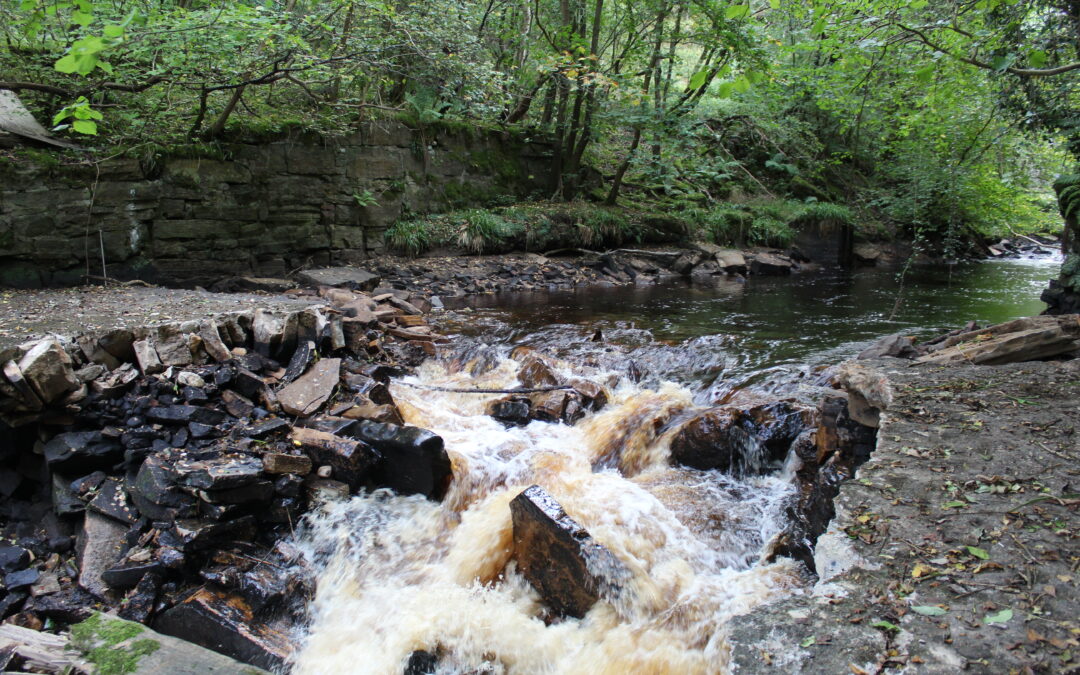
Despite having studied an environmental science course, barrier removal was not a topic we delved into at all, and was only a concept I’d heard of when I began my role with the Trust. Luckily I was given the opportunity to get a real insight into the process when Morton Quarry Weir was finally given the go-ahead for removal in September 2023, requiring a banksman to oversee the works. The site location required a unique method of removal, with the aim of letting the river do the work afterwards. I’m sure you’re getting a better understanding of the importance of barrier removal throughout this week so far, so I’ll let the photos do most of the talking from here!

When facing an aging weir, armed with hand tools and determination, first comes forming a plan. A method statement was created to guide the overall works, and the first step was to remove the weir’s concrete skin.

With actual sweat (but no blood and tears!) segments of the weir’s concrete skin were marked out and carefully hammered away. This was cautious work given the structure’s overhang of the river – every sledgehammer swing was calculated!

Works were on pause for a couple of days as September rain brought higher flows to the tributaries of the Almond – but this helped flushed out parts of the weir structure and the river began to find its way.

A wooden beam sat atop the structure holding the structure together underneath its concrete skin. For 200-year old wood that sat in a river for most of its life, we’re told it was quite the challenge to work through!

Day 7 – assessing the structure of stones beneath the now-removed wooden beam

With the top of the weir structure ‘opened up’, attention turned to some of the giant sandstone slabs underneath which were covered with fast-flowing water. The slabs were sitting around 1m in height from the downstream pool – still presenting a challenge to fish passage.

With some careful planning and a lot of winch heaving, the sandstone hurdle was soon overcome.
Some tactical use of a pinch bar allowed for redistribution of the boulders and gravels that had previously built up in the impoundment, creating a more naturalised river channel and giving the water and gravels in the river some space to settle out.

After a week and a half, the Linhouse Water was transformed – and fish could access over 5km of pristine upstream habitat, for the first time in over 200 years!

On site for the final day we examined some aspects of the weir’s construction. The barrier itself was a laid sandstone structure, strengthened by wooden beams with a concrete skin. Below, some material removed from the weir which seems to be some kind of old fibrous material coated in cement, possibly a sandbag filled with cement and left to harden at the time.

Excitingly, this removal also exposed a fossil which had been hidden deep beneath the weir structure. After some deliberating, we identified this as a Lepidodendron fossil, a primitive vascular plant from around 300-360 million years ago!


Overall, this was an incredible experience to capture just what really goes into a barrier removal, especially being able to witness this unique method required which provided an opportunity to further the Trust’s learning. For me, seeing fish attempt to leap the weir during the final few days was truly inspiring, a real demonstration of how valuable free-flowing rivers are for our freshwater species. I’ve attached a video below, but it doesn’t quite capture just how many fish were attempting passage at the time. They must’ve sensed a shift in the river.
It was a privilege to oversee part of this weir removal process and it highlights just how important the agenda of free-flowing rivers is for the Forth catchment, and Scotland as a whole. Approximately 72% of the Forth’s barriers are impassable to migratory fish, and with Atlantic salmon now endangered, the mission to unlock fish habitat is now more vital than ever. The benefits of barrier removal are clear – the river will find a way, and sometimes it just needs a helping hand.

The removal of Morton Quarry Weir was delivered by Forth Rivers Trust and funded by the European Open Rivers Programme.