
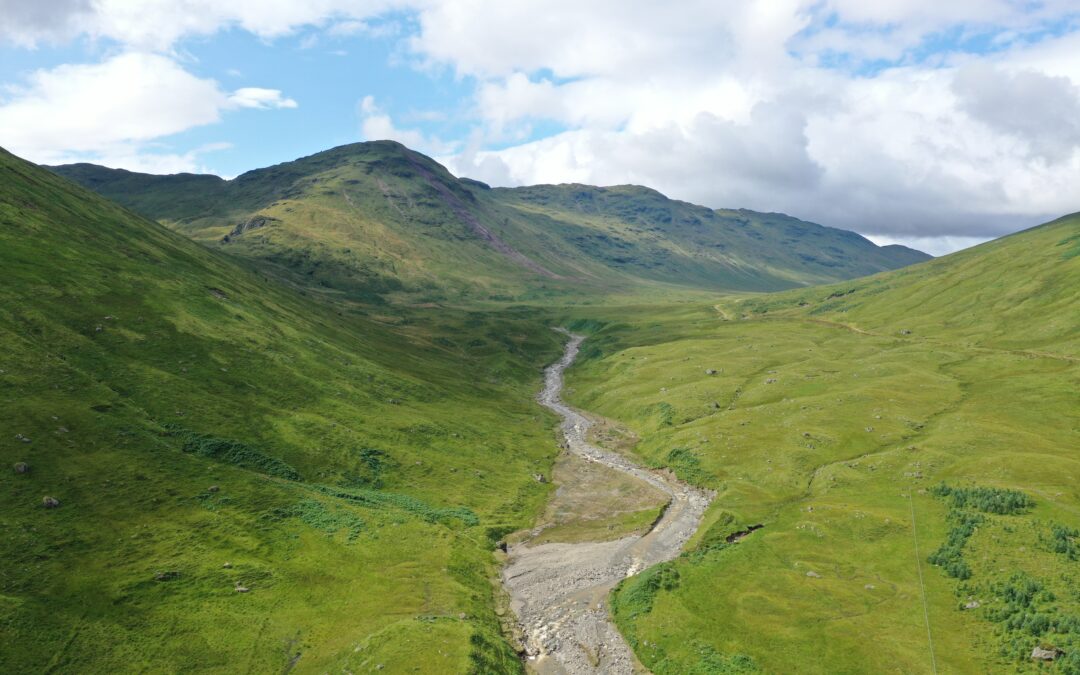
Given Scotland’s typical reputation for being a place of cold and grey, overcast, rainy days, I’m sure that many of us are enjoying the sunny spells we see across the country at the moment. With the heatwave temperatures, however, comes the issue of water scarcity that impacts human and wildlife populations alike. But why are we currently experiencing water scarcity in Scotland, and what does this mean for our rivers? Read on to find out more.
Both rainfall and temperatures play a huge factor in regulating our waters. Across the entirety of the UK, winter rainfall was lower than average with only 83% of the Met office predicted average rainfall recorded. We can see average rainfall amounts in the Met Office image below.
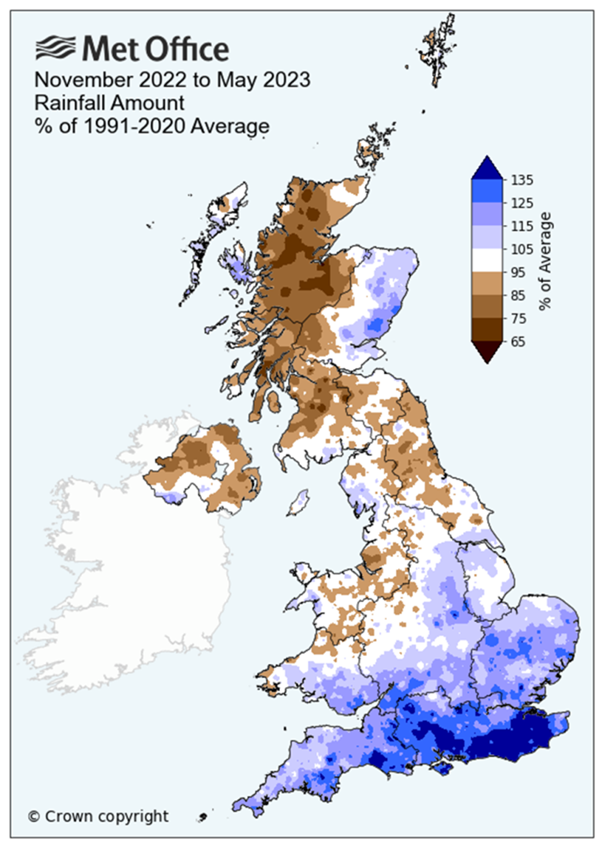
Above: Met Office rainfall over from November 2022 to May 2023 (inclusive) compared with average. Blue areas indicate above average rainfall for the seven-month period, whereas brown shaded areas experienced below average rainfall and whiter areas indicating closer to average levels (from this blog).
This year, Scotland had a drier winter than average and a particularly dry February resulting in lower-than-normal river flows and groundwater levels for this time of year and presenting greater risk of water scarcity moving towards summer with weather predictions. While the rain fell in England during a very wet March, parts of Scotland – including Inverness and Sutherland – recorded just under two thirds of their expected rainfall (64%). This is the driest spring in North Scotland since 2018.
So what does water scarcity mean for our rivers?
It’s an issue for several reasons.
The first visible sign is lowered river water levels.
In the short-term, river flows across much of Scotland have ranged between low-extremely low for this time of year, excluding parts of North-East Aberdeenshire and Western edges of Dumfries and Galloway. Medium term, very low-extremely low flows have been seen in Northern areas, and low flows noted in central Scotland. More ‘normal’ flows are evident in the South and East – but a lack of rainfall has impacted most catchments, according to SEPA data. You can check the water levels of your nearest river using this link.
Our heatwave conditions mean increased air temperatures = increased river water temperatures.
If you’ve felt a bit hot and bothered by some of the temperatures we’re experiencing currently, imagine how it might feel for fish in river waters as they breathe and move! This is especially an issue in river catchments that lack riparian woodland – the shade and the cover that trees provide along these river margins is essential for life, alongside harbouring invertebrate populations, some of which fish feed on. Prolonged periods of drought lead to higher temperatures in river water, damaging fish health and preventing spawning, which can lead to generations of fish being wiped out on some rivers during a particularly bad summer.
Upper catchment areas are more vulnerable to drought.
The higher reaches of rivers are most vulnerable to prolonged dry spells, and sometimes parts of rivers here can completely dry out. This is a loss of habitat and impacts everything relying on that area of water for life, risking generations of insects and fish when they are placed under these severe conditions for long periods of time. Removing drainage ditches and introducing wetland habitat are just some of the works the Trust does to combat the ‘flashiness’ of river catchments, re-wetting previously dried areas, building resilience for extreme weather events and benefitting wildlife in the area.
The majority of Scotland is now at least on ‘alert’ for water scarcity levels as of SEPA’s latest water scarcity report. These reports are released weekly in the months of May-September as part of SEPA’s responsibility for forecasting and monitoring water resources.
How the water warning system in Scotland works:
Scotland’s natural water levels are categorised into five grades with necessary advice for businesses at each alert level.
- Normal – Water can be taken from sources as usual.
- Early warning – Industries should consider how they can use water more efficiently.
- Alert – Industries irrigating land should check equipment, use trickle irrigation, not overspray, and should irrigate at night to avoid evaporation.
- Moderate scarcity – Industries should reduce the amount of water they take, stagger use with others nearby or switch to other supplies. In prolonged dry periods abstractors should reduce the volume of or suspend abstractions.
- Significant scarcity – Water resources are becoming scarce. Industries should switch supplies or stop abstracting water altogether.

Above: SEPA’s water scarcity reports for May, following the first water scarcity report issued on April 27th. Left is 11th May 2023, right shows 25th May 2023.

Above: SEPA’s latest water scarcity report as of June 8th, 2023. On the right hand side we can see end of May/early June’s water scarcity report. Loch Maree area is in a Significant water scarcity situation and the Ness area has increased to Moderate water scarcity, alongside the Esk area of Dumfriesshire South. The majority of Scotland is now at Alert level for water scarcity, with some areas at early warning.
Last year, saw the driest January since1940 for the East of Scotland and groundwater levels were at their lowest level since records began in 2009. Subsequently SEPA suspended 175 water abstraction licences. This year SEPA have again warned that water scarcity in Scotland is ‘expected to escalate quickly‘ over the coming weeks due to the lack of rain and high temperatures. We can see this above in how rapidly the water scarcity report outlooks have changed week-to-week, so it’s key we try and do all we can – both individually, and as businesses and organisations – to protect our water resources.
In a water scarcity situation, actions that help include: people taking shorter showers, turning off the tap while brushing teeth, using washing machines and dishwashers only when fully loaded, swapping the garden hose for a watering can, washing cars with a sponge. Any of these steps can help towards reducing your water footprint, a key consideration at this time of year that will only become more important as we see ‘heatwave’ conditions set to continue throughout summer, and predicted to worsen in years to come.
If you see or suspect that a fish is in distress or is stuck due to low water levels, get in touch with Forth Rivers Trust or contact SEPA. You can read more about water scarcity at some of the links below.
Further reading
Rivers Trust – Drought, water scarcity, and our water footprint
Met Office blog – relative lack of Spring rainfall triggers water scarcity alert
A 2022 BBC News article – Why is a wet country like Scotland facing water scarcity?